
Green Education and Legal Fund
156 Big Toad Way, Poestenkill NY 12140 – 518 860-3725 – www.gelfny.org
Testimony of the Green Legal and Education Fund Inc.
To the New York State Legislature Joint Budget Hearing on the
2026-27 Executive Budget Proposal on Environmental Conservation / Energy
January 28, 2026
My name is Mark Dunlea, and I am chair of the Green Education and Legal Fund (GELF). I am also the convener of PAUSE (People of Albany United for Safe Energy), the 350.org affiliate in the Capital District.
Our key recommendations are:
- Given the Governor’s retreat on climate action and promotion of an All Of the Above energy agenda, the legislature needs to not only take action (including providing funding) to implement the CLCPA but strengthen its goals.
- The legislature should appropriate funding that it controls via the chairs of the energy and environmental committees to develop a timely year-by-year Affordable Renewable Energy Plan to meet the various goals in the CLCPA. The detailed plan would include specific steps and projects with short-term activities, siting, budget, and performance measures.
- Take legislative action to reject Governor Hochul’s directive to NYPA to build new nuclear power plants. Amend the state energy plan to reject nuclear power.
- Enact a moratorium on new nuclear power plants in New York State;
- Raise at least $10 billion annually in new climate funding for the transition to a clean energy future, which is what the Hochul administration determined was the minimum needed when it wrote the Climate Action scoping plan. The $1 billion last year (for five years) for the Sustainable Future Fund represents only 2% of that goal. Ensure that at least 35% of such funds are invested in environmental justice communities (not just benefit).
- In addition to raising taxes on the wealthy, the legislature needs to enact a state carbon tax since Governor Hochul has delayed implementation of her proposed cap-trade-and-invest program
- Redirect the $33 billion recently approved by the PSC for an extended subsidy for four upstate nuclear reactors into renewable energy, battery storage, and energy conservation. As was agreed to when the controversial subsidy was initially approved, phase out existing nuclear (and fossil fuels) and transition to clean, renewable energy.
- Include the Renewable Capitol Act in the State Budget. This is a critical environmental justice issue, as for more than a century the state has polluted the low-income Sheridan Hollow community to heat and cool the State Capitol / Plaza complex. Appropriate $150 million in the budget to initiate geothermal at the complex.
- Appropriate $50 million in funding for district geothermal in Sheridan Hollow.
- Follow through on the Build Public Renewables Act by passing legislation to direct NYPA to build 20 GW of renewable energy by 2030 rather than their proposed 5GW. Expand the NYPA board (see Public Power Democracy Act,). Include at least $200 million in the budget for renewables.
- Not only upgrade the transmission and distribution grid for electricity but improve coordination, speed up development of renewable energy, and lower consumer costs by have NYPA take ownership of the system;
- Expand and Sustain EMPOWER+, with at least $200 million in funding. Prioritize low-income households, renters, and marginalized communities.
- Expand solar, including passing ASAP, Community SOLAR, and SUNNY; increase cost limits in Green Jobs Green NY, and increase goals for distributed solar to 20 GW;
- Enact a ban on data centers in New York;
- Enact the Bigger Better Bottle Bill;
- Pass the Packaging Reduction and Recycling Infrastructure Act.
- Ban Data Centers
- Establish the State Office of the Utility Consumer Advocate
- Enact Buck for Boilers
- $200 million for the Green Affordable Pre-Electrification (GAP) Fund
The world – and New York – has run out of time to take essential radical action to avoid climate collapse. Global warming exceeded the target limit of 1.5 degrees Celsius from 2024 while extreme weather has continued to accelerate globally. The United Nations has warned that we have run out of time to prevent climate collapse and slow actions by governments worldwide have opened up the Gates of Hell. The need for strong climate action by the state is critical with the Presidency of climate-denier-in-chief Donald Trump.
New York businesses, workers, and residents are counting on the legislature to deliver on the issues they care about with a budget that ensures affordable energy, protects public health, cuts pollution, and creates good jobs. No one voted for dirty air and water. On the contrary, time and time again New Yorkers show their broad support for actions to fund and protect the environment.
Investments into climate action and environmental protections not only help to cut costs, protect public health, and reduce pollution – these investments also often create good jobs. New York has a substantial green economy. A 2022 report from the New York State Comptroller found that the number of jobs influenced by the green economy in New York exceeded one million in 2019 and 2020. According to NYSERDA, as of 2022, there are 171,000 workers in the clean energy field. The new federal administration’s allegiance to the oil and gas industry and other corporate polluters will prevent significant opportunities for economic growth. As one example, the President has already issued an order to suspend approvals for offshore wind projects, which stands to jeopardize the creation of an estimated 14,000 jobs in New York.
Investments into climate and our environment should be understood as a prevention mechanism from even greater expenses down the road. The cost of inaction is greater than the investments necessary to meet New York’s climate goals – according to the Final Scoping Plan, by more than $115 billion. But the cost benefits of proper investment are tremendous. The Final Scoping Plan estimated the creation of enough jobs to outnumber potential displaced jobs by a ratio of ten-to-one in 2030. According to an earlier report from the Climate Action Council, net benefits of meeting New York’s CLCPA mandates are in the range of $80-$150 billion.[17] Additionally, public health benefits range from $160-$170 billion.
As Earth Justice notes in its budget testimony, “many now understand that the fossil fuel industry has spent (and continues to spend) billions over the course of decades lying about the reality of climate change and their role in causing it, forcing our continued dependence on their dangerous and costly products. As Speaker Heastie rightfully noted in his speech on the opening day of the 2026 session,[1] science-denialism, a critical tool of the fossil fuel industry’s efforts, has taken over our federal administration. But it is crucial to understand that science-denialism is far from the only insidious way the fossil fuel industry continues to mislead and manipulate the public. Their playbook also includes popularizing “all-of-the-above energy,” a dog whistle that entered the lexicon in 2000 that many elected officials will use to appear open to renewable energy, while remaining largely focused on continuing the build out of fossil fuel infrastructure.[2] It is coupled with arguments that fossil fuels are more reliable and affordable than renewable energy resources, when this could not be further from the truth.”
Enact the Renewable Capitol Act; Immediately Start Converting the State Capitol to Use Geothermal
- the Renewable Capitol Act (A3466 Romero / S4842 Fahy) which mandates that the Capitol Complex be transitioned to renewable energy, be included in the Article VII language of the 2026-2027 state budget, along with an initial appropriation of $150 million this year for planning and construction costs for a thermal energy network as identified by the Empire State Plaza Energy Infrastructure Master Plan, May 2024 (Ramboll study).
- $50 million in funding for district geothermal in Sheridan Hollow. Thanks to a NYSERDA grant, plans have been made to transition several residential blocks to geothermal energy. Unfortunately, these plans have been on hold due to the lack of funds to complete the project.
As a designated Disadvantaged Community (DAC) under the 2019 Climate Law (Climate Leadership and Community Protection Act or CLCPA), which mandates that 35%, with a goal of 40% of the funding go to DACs, Sheridan Hollow must be at the top of list the for funding the transition of state facilities to renewable energy.
Sheridan Hollow is a low income, people of color neighborhood next door to the Capitol that has been polluted for over 100 years from the burning of coal, oil, garbage and gas to heat the Capitol and Empire State Plaza. Residents of Sheridan Hollow and neighboring Arbor Hill have up to three times the expected rate of respiratory cancer.
It’s time to shut down Sheridan Hollow Steam Plant ! Stop polluting Sheridan Hollow and stop releasing greenhouse gas emissions that are destroying our climate.
- In 2017 NYPA proposes a new fracked gas power plant in Sheridan Hollow. SHARE opposes the plant and calls for the transition of the Capitol Complex to renewables.
- In 2019 the legislature rejects NYPA’s proposal and reallocates the $88 million for the plant to be directed toward renewable energy projects. NYPA uses the funds to improve lighting and switched one of the chillers from gas to electric. However, seven years later, $21 million remains unspent.
- In 2020 the Office of General Services (OGS) commissioned a study to develop an “Energy Master Plan” for the plaza. OGS and NYPA didn’t consult SHARE or the community about what should be in the study and ignored our FOIL requests for more information.
- In 2024 the Ramboll study is finally released and calls for a 50% reduction in greenhouse gas emissions over ten years, (by 2035) predominately by moving the Wadsworth Lab out of the Corning Tower and adding electric chillers. This is less than the 40% emission reductions required by New York’s Climate Law by 2030.
- In ten to fifteen years, during “Phase 3.2” of the Ramboll Study, the Study recommends $150 million for a thermal energy network which may, or may not be fully renewable (i.e., the Study does not say). This is 17 years since SHARE called for a renewable Capitol.
In the 2023-24 state budget, the legislature appropriated $30 million to establish decarbonization action plans for fifteen of the highest-emitting state-owned facilities. The Capitol complex is one of the top three top emitters. NYPA is just now developing plans for the studies that are required to be completed by this month. We call on NYPA and the governor to put the Capitol Complex at the top of the list.
As communities in our state deal with ever increasing climate destruction of superstorms, wildfires, floods and drought, instead of stepping up to the task, the Hochul administration has decided to slow-walk climate action and back petal on the mandates of the Climate Law.
According to geothermal experts, there is no reason to delay geothermal for the Capitol. Work on the thermal energy network could be done in conjunction with the maintenance work planned for Phase 1 of the Ramboll study. The State of Michigan recently took 18 months from start to finish to convert its state Capitol to geothermal energy and is already seeing savings. Oklahoma, Michigan and Colorado all heat their Capitols with geothermal, as does St Patrick’s Cathedral in New York City. We must ask ourselves, why does New York continue to delay?
We urge NYPA and OGS to acknowledge the urgency of the climate crisis and move forward with bold plans to transition all state facilities to renewables. We call for an open public process which includes communities that are directly impacted, climate organizations that helped pass the Climate Law, and all who have the expertise to develop solutions. If New York can’t get its own house in order, how can we expect private industry to meet the Climate Law goals?
Three states presently use geothermal to power their capitol – Colorado, Oklahoma, and Michigan. Michigan was the most recent to convert, completing the project within 18 months after first studying it while providing 500 construction jobs. The geothermal system at the Michigan State Capitol is expected to pay for itself in about 10 years. The system was installed in 2017 as part of a $70 million project to improve the building’s facilities.
The Capitol and Plaza should be a priority due to their symbolic significance as the house of New York’s government. In addition, the continued operation of the Sheridan Avenue Steam Plant (SASP) which has polluted a low-income people of color neighborhood for over a hundred years to heat and cool the Capitol Complex is contrary to New York’s environmental justice policy. The plant has burnt coal, oil, trash and now gas. Department of Health statistics show that the area around the SASP is one of three cancer clusters in Albany County. The state is literally poisoning its neighbors in order to heat and cool the Capitol and Plaza.
Work on the Capitol will provide state policymakers and state agency staff with the ability to see for themselves how the transition to renewables can be done and provide a roadmap on how to build a workforce that is ready to take on the necessary buildout of thermal networks to transition our state buildings to renewable energy.
New Nuclear Power Plants are a False Climate Solution
Governor Hochul and NYSERDA are attempting to launch a new generation of nuclear power plants in our state without an adequate public participation process and little to no consideration of this technology’s serious health, environmental and economic problems.
The 2022 Scoping Plan recommendations are largely being ignored by the Governor. Climate Action Council’s (CAC) Scoping Plan recommendations on nuclear energy technologies is best expressed by CAC member and Cornell University Earth Science Professor, Dr. Robert Howarth: “The NYS CAC decided against any major role for new nuclear power plants in the energy future for NYS. Nuclear power is simply too expensive … and the state’s needs are far better met by renewable energy and battery storage.”
The legislature in the budget should insert a cancellation of Governor Hochul’s unaffordable and irresponsible nuclear energy proposals in the 2026 State Budget. The proposals are moving forward without any financial or environmental assessment, legislative oversight and little public input, and in direct conflict with the legislative intent of the CLCPA. Behind closed doors, in the last two years, Governor Hochul, the New York State Energy Research & Development Authority (NYSERDA), New York Power Authority (NYPA) and Public Service Commission (PSC) have developed and approved monumental, far-reaching nuclear energy proposals which severely undermine the implementation of the CLCPA-required renewable energy transition to address the worsening climate crisis, that seeks to burdens ratepayers and taxpayers with a massive bill for as much as $96.5 billion. The cost of the most recent two reactors in America is approximately $19.3 billion each.
NYS Needs to Strengthen the CLCPA with an Adequately Funded Annual Budget and Annual Plan of Action with Performance Requirements & Enforcement Provisions.
When the CLCPA passed in 2019, there were no requirements for an annual budget, and thus there was no sustainable funding stream of revenue to implement the law. There were no requirements for the state agencies and authorities to develop and approve, with public input and legislative oversight a plan of action with yearly performance requirements for the state and GHG emitting businesses and the fossil fuel industries. Reports were required only every 4 years. This was basically no budget or plan as to how the state would achieve the 2030, 2040 and 2050 statutory goals. Three years later the Climate Action Council released a Scoping Plan with general recommendations for action. This plan has been largely ignored by both the Governor and the Legislature.
What has occurred under Governor Hochul’s administration on CLCPA implementation and funding? She vetoed a bill that would have required an annual tally of what agencies are currently spending on the climate crisis. She has irresponsibly neglected to require state agencies to develop a budget, to then fund that budget with a mix of revenue streams, and to develop an annual plan of action to meet the CLCPA goals with the public and the legislature.
Instead, she has delayed or opposed the implementation of key CLCPA-required policy reforms and funding proposals, such as the All-Electric Building Act, Cap and Invest regulations and the NY HEAT Act. The state is now six or more years behind in reaching the 2030 goals without a renewable energy transition plan and little funding for the CLCPA as the climate crisis worsens. The Governor has put all her focus and funding into nuclear energy and fossil fuels without any financial or CLCPA-focused assessment of these polluting and highly expensive energy sources.
Myriad problems with nuclear power.
As NY Renews points out, “The use of nuclear energy holds a multitude of structural and systemic problems that undermine its viability as a sustainable climate solution. Nuclear energy’s high capital costs, unresolved waste legacy, environmental harms, and inequitable social impacts render it a short-sighted and risky option when compared to renewable alternatives. Safety risks remain a central concern, as both catastrophic failures and routine operations demonstrate the potential for long-term contamination of land, water, and human communities. Even under normal conditions, nuclear reactors emit radioactive effluents, while uranium extraction has historically imposed disproportionate health and environmental burdens on Indigenous communities through radiation exposure, ecosystem destruction, and violations of sovereignty.”
“The construction of just two reactors in Georgia led to nearly a 25% increase in consumer electricity rates, while South Carolina residents continue to pay approximately 10% of their utility bills for canceled reactors that consumed over $9 billion in public investment. New York itself has a long history of failed nuclear development, with more canceled reactor projects than any other state, including the fully constructed Shoreham facility, whose costs are still borne by Long Island ratepayers decades later. This pattern reveals a direct opportunity cost: each dollar allocated to nuclear expansion represents a dollar not invested in scalable, rapidly deployable renewable infrastructure. Framing nuclear development as a climate solution thus constitutes a strategic distraction, particularly in light of proposals to pursue a 5GW nuclear target while underinvesting in far more impactful alternatives, such as expanding the New York Power Authority’s renewable buildout to at least 15GW. Empirically and economically, increased reliance on nuclear energy systematically delays the energy transition by crowding out the very technologies—wind, solar, and storage—that are essential for achieving decarbonization at the necessary speed and scale.”
Recent studies found that individuals living near nuclear power plants had increased cancer risks, with risks often decreasing beyond 30 km. Research highlights higher incidences of specific cancers, including leukemia, thyroid, breast, and lung cancer, particularly in older adults and children living near these facilities.[3]
Nuclear power is not carbon free when the lifecycle of the plants are considered, with carbon emissions occurring during construction; mining, processing and transportation of the uranium fuel; and the storage of the dangerous radioactive wastes for tens of thousands of years. Nuclear power continues to have significant safety problems. While the industry likes to portray the 1.5% rate of major accidents such as core meltdown as “minor,” such incidents in fact have caused tremendous harm. The industry has been plagued by long construction delays and massive cost overruns
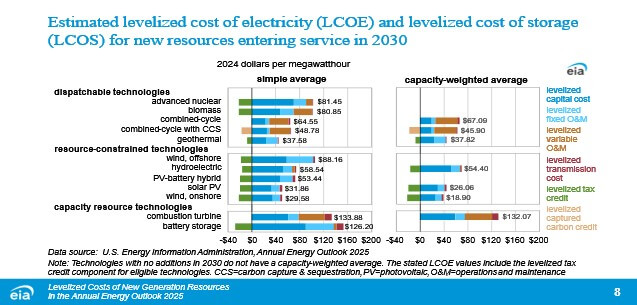
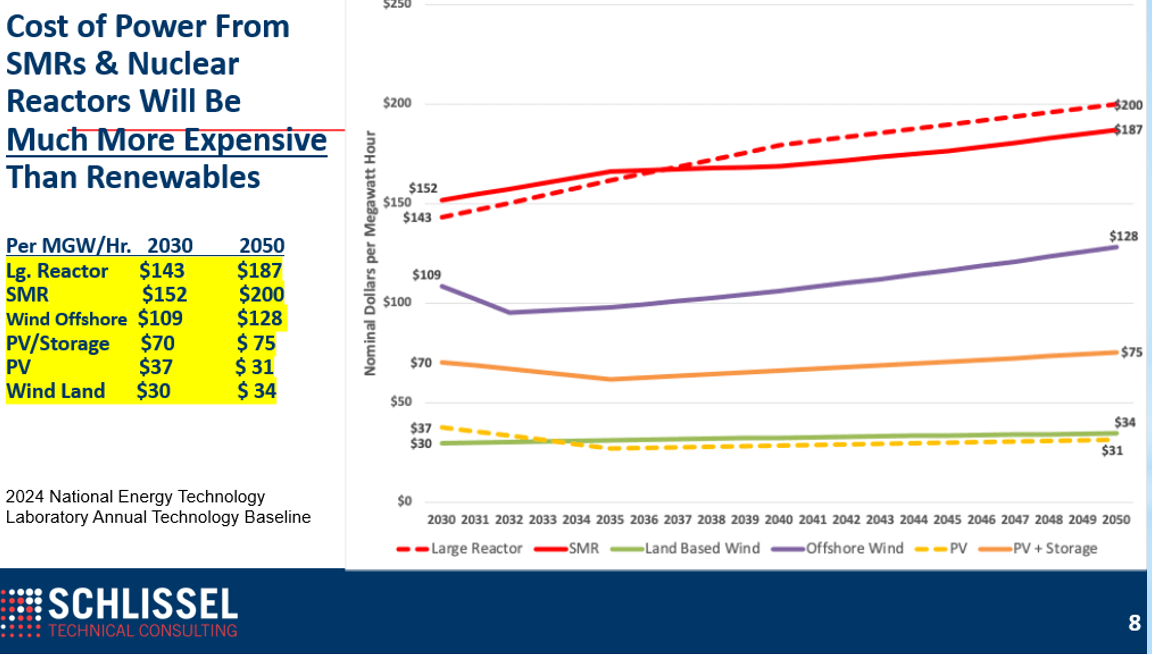
Renewables are cheaper. By 2050, the Levelized Cost of Energy for utility-scale solar PV is expected to be around $25/MWh and for onshore wind around $35/MWh, while advanced nuclear power is projected to remain at $110/MWh, according to the U.S. Energy Information Administration. the 2023 Renewable Power Generation Costs indicated that the global weighted average levelized cost of electricity for newly commissioned utility-scale solar photovoltaic, onshore wind, offshore wind, and hydropower projects experienced a downward trend. Cost estimates for nuclear power generally do not include the cost of the major nuclear meltdowns that have taken place. Lazard’s cost estimate does not include the cost of the major nuclear meltdowns in history. For example, the estimated cost to clean up the damage from three Fukushima Daiichi nuclear reactor core meltdowns, is $460 to $640 billion. Such cost figures also ignores the $500 million spent yearly to safeguard high-level waste from about 92 civilian nuclear reactors. (And smaller, experimental small reactors are likely to be more expensive due to less economies of scale.)
“Nuclear Renaissance” Is An Industry Sales Pitch for More Corporate Welfare. As Amory Lovin notes: “An intensive influence campaign seeks to resurrect a “nuclear renaissance” from the industry’s slow-motion collapse as documented in the independent annual World Nuclear Industry Status Report. Claims that past failures won’t recur have convinced many politicians that socializing nuclear investments rejected by private capital markets, weakening or bypassing rigorous safety regulation, suppressing market competition, and commanding military reactor and data-center projects as a national-security imperative will restore nuclear expansion and transform the economy. This illusion neatly fits the industry’s business-model shift from selling products to harvesting subsidies.
“Even the most skilled firms and nations keep delivering big reactors with several times the promised cost and construction time. A swarm of startup firms that have never built a reactor are dubiously rebranding their inexperience as a winning advantage. New designs are said to be so safe they don’t need normal precautions (though not safe enough to waive nuclear energy’s unique exemption from accident liability).” The previous “nuclear renaissance” in the US several decades ago resulted in one new nuclear plant coming online.
Small Modular Reactors are not cheaper, safer or cleaner. Small Modular Reactors (SMRs) face problems with higher costs, extended timelines, greater nuclear waste challenges, potential safety vulnerabilities due to less containment than traditional plants, increased security risks, and significant technical and regulatory hurdles. The promised benefits of faster construction and lower costs are not being realized, as regulatory approval, the development of the supply chain for parts and fuel, and the management of waste and security all present significant challenges.
Renewable Energy Can Deal with the Intermittent Issue
Nuclear advocates claim it is still needed because wind and solar are intermittent and need natural gas for backup. However, nuclear power itself never matches power demand, so it needs backup. Dozens of independent scientific groups have further found that it is possible to match intermittent power demand with clean, renewable supply and storage, without nuclear or fossil fuels, at low cost. Military and industrial installations already prefer 100% renewables for their most critical applications, including Apple’s data centers in four states. Ten kinds of carbon-free resources can balance variable (but highly predictable) renewables, keeping the grid stable – as is done in a number of other countries.
Nuclear Power is exorbitantly expensive in comparison to renewables: There is no path to the construction of new nuclear reactors that will not involve a massive infusion of public dollars. New nuclear power costs about 5 times more than onshore wind power per kWh.[4] While the report denigrates “overbuilding” solar, wind, and storage as a strategy to address the intermittency of generating sources, research has found that this is the most cost effective and efficient way to power a grid.[5] “Overbuilding” could just as easily be called “building enough renewables and storage to meet our needs.” This idea should not be dismissed and deserves analysis to determine the cost and feasibility of achieving an optimized mix of renewables and storage to meet demand.
Small Modular Reactors are an unproven technology: The Draft Blueprint acknowledges there are questions of “technological readiness”, but it does not discuss the abject failure of the nuclear industry to deliver a product remotely on time or within the projected budget.[6] In addition to needed skepticism over timelines and budgets, NYSERDA should not believe attempts by the nuclear industry to sell new reactors as being somehow friendlier to the environment. Contrary to the claim that SMRs are capable of producing less waste on page 22 of the Draft Blueprint, they may create more waste than conventional designs, and waste that is more chemically reactive and volatile.[7]
Nuclear energy generates radioactive waste that is deadly for centuries: As there is no facility that will accept this deadly waste, the reactors in Oswego, Wayne, and Westchester Counties are in essence radioactive waste dumps. The shuttered West Valley nuclear reprocessing site is further testament to the failures of the nuclear industry to manage its waste in New York. It is one of the most contaminated places in the country, and despite decades of “cleanup” efforts and billions of federal and state dollars spent, this massive dump of long-lasting and radioactive waste threatens the Great Lakes watershed and the drinking water for millions of people.
The State Should Enact A Carbon Tax rather than Cap and Trade/Invest
We need to make polluters pay for the damage they have caused. Just for health care, NY residents pay an extra $50 billion annually in health care costs due to air pollution. . Of the $7 trillion estimated by the International Monetary Fund in global subsidies, the vast majority is from governments’ failure to hold polluters responsible for the damages their actions cause.[8]
With the Governing largely abandoning her cap-and-trade proposal, the state legislature needs to take the lead in enacting carbon pricing. Most economists agree that a robust carbon tax is a much better alternative than Hochul’s cap and invest. GELF helped draft a state carbon tax bill[9] in 2015 with As. Cahill (with Senator Parker). We must end the taxpayer subsidies for fossil fuels
The IMF recommends that the price of carbon should be set at least at $85 a ton.[10] There should be an annual increase of $15 to $20 a ton. DEC estimates the social cost of carbon is $121 per ton.[11] The Hochul administration is proposing an initial floor of $23 a ton.
One of the reasons why many climate groups oppose cap-and-trade is that it often enables polluters to continue their pollution in more disadvantaged communities in exchange for improvements elsewhere, a problem cited by the state’s climate justice working group and some members of the Climate Action Council. The Pope opposes such efforts: “The strategy of buying and selling ‘carbon credits’ can lead to a new form of speculation which would not help reduce the emission of polluting gases … in no way does it allow for the radical change which present circumstances require.”
The fact that California had a cap-and-trade program was the main reason the environmental justice groups blocked President Biden’s nomination of Mary Nichols, the long-time head of the nationally renowned California Air Resources Board, to head the EPA.[12]
A report several years ago by “a state-appointed panel of experts …warned that California could miss its legally binding target of reducing greenhouse gas emissions by 40 percent below 1990 levels by 2030, largely as a result of the design of the state’s complex ‘cap-and-trade’ market.”[13]
Progressive climate groups such as Friends of the Earth, Greenpeace, and the Green Party opposed the effort to establish a national cap-and-trade program during the Obama administration. Former NASA scientist James Hanson, one of the first to sound the alarm about climate change, said: The truth is, the climate course set by [the] Waxman-Markey [cap-and-trade bill] is a disaster course. It is an exceedingly inefficient way to get a small reduction of emissions. It is less than worthless….”[14]
A 2017 review of NY’s existing cap-and-trade program (RGGI) by the Congressional Research Service[15] concluded that it had not been particularly effective in reducing greenhouse gas emissions since the cap had been set too high. The Hochul administration plans to use the CLCPA emission goals for the caps. Climate groups led by Earth Justice had submitted testimony to the CAC that such an approach would be superfluous since it would not add anything to the existing effort.
Rebate at Least Half of Carbon Pricing to Consumers
Since low- and moderate-income consumers spend a higher percentage of their income on basic necessities such as energy, any energy tax is considered regressive. Steps need to be included in the design of any energy tax/penalty/pricing to make it more progressive. Governor Hochul has indicated that only one-third of the costs of her proposal will be rebated, though details are very sparse.
A traditional approach is to rebate some if not all of the “energy tax” to consumers. There are many variations to this, with pros and cons to the different approaches. (See my carbon pricing chapter[16] in my climate book.
The easiest and cheapest way to provide the rebate is through the annual state income tax filings. However, this is not an ideal situation for low-income New Yorkers, who often have limited interaction with the state income tax system. Plus, households struggling on a monthly basis to pay their bills are not helped much by receiving a tax refund once a year. One of the improvements that NY Renews proposed in their polluter penalty bill was alternative ways to provide a rebate, such as through free mass transit cards.
One of the few positive developments of the COVID crisis was that the government figured out a way to provide several stimulus checks directly to individuals. This would enable governments to adopt a similar approach for a carbon pricing rebate.
Expand Solar, the Lowest‑Cost Source of New Electricity
Solar energy is now the lowest‑cost source of new electricity generation[17], with zero fuel costs and installation costs that have declined precipitously in the last decade. Once installed, solar power shields the home or business from fuel price volatility and provides long‑term price certainty.
When solar is deployed close to where energy is used — on rooftops, parking canopies, brownfields, and as part of community solar projects — it delivers additional economic value by reducing congestion, lowering wholesale energy prices, and mitigating the need for expensive peaking generation. When paired with batteries, distributed solar becomes even more valuable, providing energy during high‑cost evening hours and peak winter demand periods.
Earlier this month, Synapse Energy Economics released a new statewide analysis[18] demonstrating that scaling distributed solar and energy storage represents a billion‑dollar affordability opportunity for New York. The Synapse report finds that scaling up New York’s distributed solar capacity to 20 gigawatts by 2035, and meeting the state’s energy storage goals, would save New Yorkers $1 billion every year on their energy bills relative to a business‑as‑usual scenario.
The Accelerate Solar for Affordable Power (ASAP) Act is designed to drive down the cost of distributed solar and energy storage projects by reducing inefficiencies, modernizing interconnection, and providing market certainty. Critically, the legislation is structured so that it does not require new appropriations or impose any direct fiscal impact on the state budget. It would increase the state’s goal for distributed solar to 20 GW.
The Governor’s proposed updates to the Green Jobs Green New York (GJGNY) program will have a meaningful and immediate impact on the residential solar market. Raising the per‑household financing cap from $25,000 to $50,000 will allow more homeowners to fully address their energy needs — including solar, energy storage, efficiency and/or electrification — within a single project, reducing long‑term costs and increasing participation.
Community Solar Opportunity and Local Approval Reform (SOLAR) Act (Parker S.8119 / Levenberg A.9087) seeks a careful balance between local decision‑making and the statewide interest in affordable energy. It preserves appropriate municipal review while ensuring that local processes cannot be used to impose blanket prohibitions on projects that meet established standards and deliver clear public benefits. This approach reflects models adopted in other states, including Illinois, where targeted guardrails have supported predictable siting outcomes.
Assemblymember Gallagher and Senator Krueger have introduced the Solar Up Now New York (SUNNY) Act, which would exempt small balcony solar, also known as portable or plug-in solar, from existing interconnection and net metering requirements. This small statutory change has the potential to make solar generation available to millions of New Yorkers who cannot install rooftop solar, either because they are renters, cannot afford the up-front cost, or do not have an appropriate roof, while preserving meaningful municipal control.
Solar advocates also support legislation to exempt retail‑scale energy storage systems from the state sales tax, recognizing energy storage as an essential companion to distributed solar at the commercial and community scale.
NYPA Taking Ownership of the Electric Grid
There is widespread agreement about the need to invest in upgrading the state’s transmission and distribution grid. GELF also supports taking public ownership of the grid to make it easier for renewable energy to connect to the grid in a timely and affordable manner.
As the Regional Planning Association notes, “The current state of the electrical grid in New York is uncertain–the upstate region, while reliable now, is seeing potential for large load growth leading to reliability shortfalls, and the downstate region faces significant reliability challenges starting as soon as summer, 2026. Generator deactivations combined with aging infrastructure and rising demand are forecast to significantly reduce margins and cause deficiencies within the electrical system. To continue to provide reliable and affordable electric service, planned generation–including solar, battery and energy storage, and offshore wind projects–and new transmission must be completed and put in service. Planning for future projects (including offshore wind transmission as considered in PPTN) should also move forward to ensure the state can quickly bring offshore wind power to the grid once federal roadblocks are lifted[19]
In NY, interconnection costs for distributed solar projects are now approximately five times higher than they were in 2020, driven in significant part by regulatory and planning structures that do not adequately incentivize utilities to control costs, prioritize efficiency, leverage technology for lower-cost solutions, or expedite project timelines.
The US Department of Energy reports that proposed renewable generation and energy storage projects face lengthy delays and high costs to interconnect them to the transmission grid. Without reforms, interconnection is likely to remain a major obstacle.[20] Grid connection requests are more than double the total installed capacity of the US power plant fleet (2,600 vs. 1,280 GW). The time required to secure a connection has increased by 70% over the last decade, and withdrawal rates remain high at 80%. Connection costs have more than doubled over the last decade.[21]
The American Public Power Association says, “The case for public ownership is supported by the need for strategic coordination and the scale of investment required to build a decarbonized electricity system. Public ownership can help overcome the challenges of underinvestment and fragmentation in the regulated private monopoly model of grid ownership and governance.”
A study in the UK found “that underinvestment is a feature…of the regulated private monopoly model of grid ownership and governance, which is unable to deliver the scale of investment and strategic coordination of deployment needed at the pace required. This model of ownership is ill-suited to the operation of this vital infrastructure and is incapable of meeting the urgent challenge of building a decarbonized electricity system.”[22]
Increased investments are also needed to implement a smart grid, which, “is an electricity network that uses digital and other advanced technologies to monitor and manage the transport of electricity from all generation sources to meet the varying electricity demands of end users. Smart grids coordinate the needs and capabilities of all generators, grid operators, end users, and electricity market stakeholders to operate all parts of the system as efficiently as possible, minimizing costs and environmental impacts while maximizing system reliability, resilience, flexibility, and stability.”[23]
Modernize the Bottle Bill
It is time to modernize New York’s Returnable Container Act, commonly known as the ‘Bottle Bill.’ It’s time to update the law to increase the deposit value, include popular non-carbonated beverages, wine, spirits, hard cider, and other beverage containers. Expanding the type of beverages in the Bottle Bill deposit program will result in billions of bottles being diverted from landfills and incinerators. An expanded Bottle Bill will further reduce pollution, especially plastic pollution, all while lifting up workers in the recycling and redemption industry.
GELF supports Senate bill 5684 (May) Assembly bill 6543 (Glick) that includes:
- A minimum ten cent deposit
● Deposits on all beverage containers except milk and 100% juice
● A handling fee of 6.5 cents, increased gradually
● Codification of the fraud task force and reporting requirements
● Language supporting refill and reuse
In addition, we support environmental standards for beverage containers that require refillable containers within a refill system to reduce plastic pollution, and a definition of recycling that clearly excludes “chemical recycling” technologies.
Including the Bottle Bill in the state budget has clear fiscal implications. Raising the deposit and expanding the types of covered containers would generate an estimated $100 million in revenue, which could help fund the Department of Environmental Conservation and the Environmental Protection Fund. Further, modernizing the bill would save local governments money by diverting containers from the waste stream, thus reducing transport and disposal costs. The most recent data from DEC shows New York’s redemption rate stands at 65%, or 5.5 billion of a total of 8.6 billion deposit containers. Other states, including Michigan that have raised the deposit to ten cents see a redemption rate of 90%. It’s important to note that state revenues would increase even with an increase in redemption due to the higher deposit value and more deposit containers in the system – a win win.
Increasing the handling fee from 3 cents to 6.5 cents per container is crucial to improve redemption access and support the infrastructure that makes the bottle bill possible. The handling fee is completely separate from the deposit and is paid by the deposit initiator to redemption centers and retailers that accept deposit containers back. More than 200 redemption centers have closed across the state in recent years due to the lack of handling fee increase. These small businesses support waste reduction, green local jobs, and importantly make redemption easy for the consumer. The handling fee investment is necessary to ensure that containers can be conveniently redeemed, and consumers get their deposit back.
GELF supports an amendment to the above bill to include refill requirements that will address immense plastic pollution from plastic bottles. Not long ago, most beverages were sold in reusable glass bottles with a fifty-cent deposit. This system has been replaced by single-use plastic bottles that are not effectively recycled into new bottles. One million single-use plastic bottles are produced every minute – adding up to more than half a trillion bottles per year. Globally, the world’s largest beverage manufacturers are also the biggest plastic polluters.
Expand the type of covered beverage containers. Modernization expands the types and number of beverage containers covered by the Bottle Bill. Other states from Maine to California include a diverse range of non-carbonated beverages, wine, and liquor with great success. Any modernization plan appropriately exempts all dairy, dairy-like, and 100% vegetable and fruit juice containers.
Increase the amount of the deposit to a dime. The impact of the nickel deposit that was approved in 1982 has eroded over time. A mere inflation update would likely make that deposit nearly fifteen cents. To ensure that those who wish to redeem their deposits can easily do so, we need a portion of the additional revenues collected by the state to be used to ensure better compliance and enhance access to redemption entities. Oregon has already increased deposits on beverage containers to 10 cents, leading to an immediate increase in recycling redemption rates. An additional benefit is that an increased deposit (plus an expansion to new containers) will help “canners,” those hard-working individuals who collect redeemable containers that are discarded by the original consumer.
Increase the “handling fee,” which has not been increased in 15 years. The “handling fee” is the funding stream for redemption centers, entities which exist to make it easier for consumers to redeem containers as well as helping the state’s redemption rate. As you know, the costs of running a business have significantly increased over the past 15 years, but the funding for redemption centers has not. As a result, over 100 centers have had to close, thus undermining the program, reducing consumer convenience, and costing the state jobs. We urge that you include a phase-in increase in the fee as part of your budget.
Modernization has other benefits as well. The bill’s reuse provisions would reduce single-use plastic bottles that are made from fossil fuels, bringing them more in alignment with NYSERDA’s Climate Plan by phasing out single-use packaging. Deposit programs are also much better for glass recycling. The recovery rates for glass containers under deposit are 2-3 times the rate as they are recycled in curbside programs. The quality of material is significantly better, without contamination, such that the glass from the bottle deposit program is virtually all returned to glass container manufacturing plants in New York and neighboring states in the region.
The above provisions, plus other important reforms, are included in S.237-C/A.6353-A of the 2024 legislative session. We support that bill and urge you to include it as part of your executive budget or embrace it as a program proposal. Modernization of the law was included as part of the DEC’s “New York State Solid Waste Management Plan: Building the Circular Economy Through Sustainable Materials Management (2023 – 2032).”
Including the Bigger, Better Bottle Bill in the FY 2025-2026 Executive Budget or as a program proposal will bolster the state’s efforts to reduce litter, enhance recycling, create jobs, lift up canners in disadvantaged communities, expand equity, and ease consumer participation.
Enact the Packaging Reduction and Recycling Act
GELF recommends that the New York State Legislature adopt a strong Packaging Reduction and Recycling bill this session. When it is adopted, Assembly bill A1749, sponsored by Assemblymember Glick, and Senate bill S1464, sponsored by Senator Harckham, will be the most effective waste reduction bill in the nation. The bill would:
- Reduce plastic packaging by 30% incrementally over 12 years;
- Require all packaging — including plastic, glass, cardboard, paper, and metal — to meet a recycling rate of 75% by 2052 (with incremental benchmarks until then);
- Prohibit the harmful process known as chemical recycling to count toward achieving these recycling rates;
- Prohibit 17 of packaging’s worst toxic chemicals and materials, including all PFAS chemicals, polyvinyl chloride (PVC), lead, and mercury;
- Establish a modest fee on packaging paid by product producers, with new revenue going to local taxpayers; and
- Establish a new Office of Inspector General to ensure that companies fully comply with the new law.
Reducing waste will save a huge amount of local tax dollars.
A Beyond Plastics analysis of nine selected communities across New York state (including New York City) estimated more than $400 million in savings each year after adopting the Packaging Reduction and Recycling Infrastructure Act (PRRIA – A1749 Glick/ S1464 Harckham). This analysis includes annual waste reduction savings as well as an estimate of the revenue local governments will make when plastic polluters pay in New York City, Buffalo, Syracuse, Hempstead, North Hempstead, Smithtown, Oyster Bay, and Islip.
That $400 million savings could cover more than half of statewide recycling spending. A previous report from Beyond Plastics, “Projected Economic Benefits of the New York Packaging Reduction and Recycling Infrastructure Act,” shows how New Yorkers would save $1.3 billion in just one decade after PRRIA becomes law, thanks to the money saved from reducing waste alone. Producer fees will increase this number even more.
The production, use and disposal of plastic is one of the greatest environmental and health threats of our time and disproportionately impacts low-income communities and Black, Brown, and Indigenous people. The rise of plastic waste, and plastic packaging in particular, has led to immense challenges for nearby and downwind communities where these plastics are either produced, landfilled, or incinerated, and has frustrated efforts to reduce waste and greenhouse gas emissions.
The New York Climate Law Scoping Plan directed the New York State legislature to pass an Extended Producer Responsibility (EPR) bill for packaging and other materials in 2023 as the main legislative route for reducing waste and greenhouse gas emissions from materials and improving recycling. The Packaging Reduction and Recycling Infrastructure Act is another name for EPR. When put in place, it will be a powerful tool for mitigating pollution from materials production, use, and disposal. However, New York must get the details right or this policy will NOT decrease the use of virgin materials, plastic pollution, and greenhouse gas emissions.
The climate scoping plan calls for a complete phaseout of single-use packaging, a reduction of toxics in materials and products, investments in reuse and refill systems, and major improvements to recycling and composting infrastructure, with disposal being the absolute last resort.
The Legislature has a golden opportunity to save tax dollars and protect the environment by passing the Packaging Reduction and Recycling bills currently proposed: Senate Bill S1464 by Senator Harckham and Assembly Bill A1749 by Assemblymember Glick.
Almost half of all plastic produced is used for packaging, most of it single use. While metal, paper, cardboard and glass packaging can be made from recycled material and can be recycled many times – most plastics cannot. Plastic is recycled at a 5-6% rate in the United States.[24] And the latest marketing attempt by the plastics industry, called “chemical recycling” is a dangerously polluting dead end.
The Organization for Economic Cooperation and Development (OECD) predicts that the amount of plastic wasted annually is on track to triple: from the roughly 350 million tons wasted in 2020 to a projected 1 billion tons wasted by 2060.[25] This growth is spurred by the petrochemical industry rushing to build new plastic production plants that rely on a glut of natural gas from hydrofracking.
Plastic is being measured everywhere, and microplastics are entering our soil, food, water, and air. Scientists estimate people consume, on average, hundreds of thousands of microplastic particles per year, and these particles have been found in human placenta, breast milk, stool, blood, lungs, and more. Scientific research continues to find that the microplastics problem is worse than previously thought: New research in the New England Journal of Medicine shows that microplastics are linked to increased heart attacks, strokes and premature deaths. Another study from Columbia University found that bottled water can contain hundreds of thousands of plastic fragments.
Plastic production is warming the planet four times faster than air travel, and it’s only going to get worse with plastic production expected to double in the next 20 years. Plastic products are made from fossil fuels and may contain as many as 16,000 chemicals, many of them known to be harmful to humans and even more untested for their safety.
The Packaging Reduction and Recycling Infrastructure Act (S1464 Harckham/A1749 Glick) will transform the way our goods are packaged. It will dramatically reduce waste and ease the burden on taxpayers by making companies, not consumers, cover the cost of managing packaging. The bill will:
Each year that we postpone legislative action to reduce plastics, the problem grows, as plastic production is on track to triple by 2060. Roughly 40% of new plastics are already used for single-use packaging. These plastics cannot be effectively recycled into new packaging or bottles. A small percentage is downcycled, often into textiles, which release microscopic plastic fibers into waterways. The rest of packaging waste is incinerated, landfilled, or winds up in the environment.
Ban Data Centers
We need to slam the brakes on water-guzzling, energy-intensive data centers. While such centers create myriad problems, they do not provide significant number of jobs. The rapid expansion of data centers across the United States, driven by the generative artificial intelligence (AI) and crypto boom, presents one of the biggest environmental and social threats of our generation. This expansion is rapidly increasing demand for energy, driving more fossil fuel pollution, straining water resources and raising electricity prices across the country. All this compounds the significant and concerning impacts AI is having on society, including lost jobs, social instability and economic concentration.
The harms of data center growth are increasingly well-established, and they are massive. They include:
- Enormous electricity consumption: A tripling of data centers in the next five years would result in data centers consuming as much electricity as about 30 million households.
- Unsustainable water consumption: A tripling of data centers would require as much water as is used by 18.5 million households – simply for cooling the computer servers.
- Contribution to climate change: 56 percent of the electricity used to power data centers is sourced from fossil fuels.
- Skyrocketing electricity costs: Electricity rates have increased 21.3 percent from 2021 to 2024 – drastically outpacing inflation – driven largely by the rapid build-out of data centers, something that could continue to escalate over time.
- Job losses: According to an AI executive, AI could negate half of all entry-level white-collar jobs in the next five years and spike overall unemployment by up to 20 percent.
The rapid, largely unregulated rise of data centers to fuel the AI and crypto frenzy is disrupting communities across the country and threatening Americans’ economic, environmental, climate and water security. We urge you to join our call for a national moratorium on new data centers until adequate regulations can be enacted to fully protect our communities, our families, our environment and our health from the runaway damage this industry is already inflicting.
Energy Affordability, Utility Accountability, and Climate Justice
We endorse the proposals advanced by Citizen Action.
Across the state, greedy utility companies are raising rates to unsustainable levels for the average New Yorker. While Governor Hochul has provided some language in her Executive Budget surrounding utility transparency and accountability, she unfortunately also vetoed the bill to create the Office of the Utility Consumer Advocate last year.
Establish the State Office of the Utility Consumer Advocate
The Office of the Utility Consumer Advocate would fight for the interests of utility ratepayers, presenting a strong and dedicated counterbalance to the ultra-wealthy utility companies at the negotiating table with the Public Service Commission when it comes to considering new rate hikes. We urge the Legislature to support the establishment of the “State Office of the Utility Consumer Advocate” to represent residential utility customers before the PSC and other state and federal agencies (S.6277-Scarcella-Spanton/A.2468-Dinowitz).
The Governor’s Executive Budget Affordability Proposals
The Governor has stated the need for measures to strengthen the capacity of the Public Service Commission (PSC) to reign in high utility rate hikes. However, her proposals are not strong enough to address the numerous shortfalls consumer advocates have identified with the PSC. For example, a provision in Part P of the transportation, economic development and environmental conservation (TED) budget bill would require the appointment of an “affordability monitor” following any decision by the PSC “that results in an energy burden greater than three percent” for customers in regard to their gas or electric service. This monitor will have the authority, among other things, to examine the books, accounts and other records of utility companies. But following the monitor’s investigation, he or she is only mandated to report the “primary cost drivers that caused the energy burden to rise more than three percent.” There does not appear to be any mandate for Commission action in response to these recommendations to reduce consumer energy burdens.
We are encouraged by the provision in Part N of the TED Executive Budget bill that requires each application for a major change in rates filed by a gas or electric corporation to include an alternate “budget constrained proposal” that does not increase the applicant’s aggregate revenue by more than the annual consumer price index. We are hopeful that this will provide ideas to enable the Commission and advocates participating in rate cases to advance proposals to at least ameliorate the overall rate increases that residential customers will ultimately pay. However, we are concerned that a consequence of this proposal may be that energy savings measures or other measures that help the state to comply with the CLCPA will not be included in the budget constrained proposal. We therefore recommend the addition of language that would ensure that the budget constrained proposal strongly advance the greenhouse gas emissions reduction mandated by the CLCPA, so that rate savings are not achieved at the expense of the climate.
Bucks for Boilers (A.6489-Stirpe/S.3476-Rivera)
Starting in 2030 for smaller buildings and 2035 for larger ones, the Bucks for Boilers bill would provide necessary subsidies to households to repair and weatherize their homes and upgrade to clean and higher efficiency heat pumps, phasing out old climate polluting gas-fueled boilers when their systems need replacement. The bill authorizes $50,000 per household for the work and offers upfront full-coverage subsidies to low- and moderate-income households.
Support for various budget proposals via Earth Justice
Excelsior Power
The Governor’s proposal includes $33 million for a new program to incentivize grid flexibility through the adoption of smart thermostats and other technologies. According to the Governor’s State of the State Address, this program would give utility customers who opt to have smart meters installed credits of $25 per month; however, this program has not been detailed in any of the Governor’s budget bills. We urge the Governor and Legislature to detail the program in program text within the budget.
Weatherization Assistance Program (WAP)
The federally funded WAP program helps customers achieve long-term energy affordability through weatherizing their homes. Historically, 10% of federal Home Energy Assistance Program (HEAP) funding from the federal government has funded WAP, but this year the Hochul administration is planning to redirect the money away from WAP, creating a 60% reduction in the program’s funds and putting hundreds of jobs at risk. We urge the Governor and Legislature to specify in the State Operations Bill that 10% of HEAP funding should continue to be allocated to the Weatherization Assistance Program.
Tackling Utility Costs
The Governor is proposing steps to protect more tenants from utility shutoffs; more must be done to protect consumers from skyrocketing utility bills and hold utilities accountable.
Unfortunately, the Governor’s proposals to modernize utility rate regulation will result in unnecessary administrative costs and burdens without any meaningful cost savings or protections for rate payers.
While we are glad the Governor wants to minimize energy burdens; however, the PSC already aims to limit the energy burden for low-income households to 6% or less of their annual household income yet the agency’s policy is rarely enforced. This has been a key provision of the NY Heat Act which we supported.
We urge the Governor and legislature to modify the proposed language and include: in lieu of paying for an independent affordability monitor, the PSC must (1) set benchmarks for EAP enrollment, (2) direct DPS to critically examine utilities’ EAP outreach, education, and enrollment, to ensure the most at risk customers are enrolled and (3) evaluate and implement additional energy burden relieve programs, such as percentage of income payment plan or an expanded bill credit for LMI/DAC customers.
We encourage the Governor and Legislature to consider measures such as a Utility Intervenor and a Utility Intervenor Fund, a model that has been successful in other states that would enable ratepayers to have a voice in rate cases.
$200 million for the Green Affordable Pre-Electrification (GAP) Fund
This essential program was established in 2025. When adequately funded, the GAP Fund will ensure that every New Yorker has the opportunity to participate in cost-saving energy efficiency and electrification programs. The program addresses pre-efficiency and preelectrification costs (like roof repair, mold mitigation, and electrical upgrades) that present major barriers for many households to be able to enroll in the EmPower+ and Clean Heat Programs. We urge the legislature to include the GAP Fund legislation S3315A/A.2101 (Gonzalez/Kelles) in the budget and increase funding to $200 million to ensure the program has enough money to get started and can serve at least 10,000 households.
At least $200 million for a new fund to help oil customers save money with heat pumps
1.5 million households in New York are stuck with old, dirty oil heating and hot water systems when they could save an average of $1,947 per year by upgrading to efficient heat pumps. The main barrier is that cash strapped households lack the up-front funds to invest in heat pumps in order to realize the longer-term energy affordability benefits. A new fund would assist customers that heat with fuel oil and other delivered fuels like propane, kerosene, and coal to purchase heat pumps to bring down their monthly energy costs and reduce air pollution and greenhouse gas emissions.
[1] The Remarks of Speaker Carl E. Heastie Opening the 249th Legislative Session, January 7, 2026, https://nyassembly.gov/Press/?sec=story&story=116355
[2] “All-of-the-above energy policy,” Ballotpedia, accessed January 24, 2026, https://ballotpedia.org/All-of-the-above_energy_policy
[3] Cancer risk may increase with proximity to nuclear power plants, Harvard School of Public Health, https://hsph.harvard.edu/news/cancer-risk-may-increase-with-proximity-to-nuclear-power-plants/
[4] Stanford University Professor Mark Jacobson’s 2024 U.S. House of Representatives testimony, titled “Seven
Reasons Why New Nuclear Energy is an Opportunity Cost That Damages Efforts to Address Climate Change and Air
Pollution” https://web.stanford.edu/group/efmh/jacobson/Articles/I/24-01-MZJ-HRTestimony.pdf
[5] Budischak, C., Sewell, D., Thomson, H., Mach, L., Veron, D. E., & Kempton, W. (2013). Cost-minimized combinations of wind power, solar power and electrochemical storage, powering the grid up to 99.9% of the time.
Journal of Power Sources, 225, 60–74. https://doi.org/10.1016/j.jpowsour.2012.09.054
[6] Ramana, M. V. (2024, January 31). The collapse of nuscale’s project should spell the end for small modular nuclear reactors. Utility Dive. https://www.utilitydive.com/news/nuscale-uamps-project-small-modular-reactor-ramanasmr-/705717/
[7] Krall, L. M., Macfarlane, A. M., & Ewing, R. C. (2022). Nuclear waste from small modular reactors. Proceedings of
the National Academy of Sciences, 119(23). https://doi.org/10.1073/pnas.2111833119
[8] https://www.imf.org/en/Topics/climate-change/energy-subsidies
[9] https://assembly.ny.gov/leg/?default_fld=&leg_video=&bn=A00077&term=2021&Summary=Y&Text=Y
[10] https://www.reuters.com/business/environment/imf-chief-says-countries-should-shift-fossil-fuel-subsidies-fight-climate-change-2024-01-17/
[11] https://www.dec.ny.gov/docs/administration_pdf/vocguid22.pdf
[12] https://caleja.org/2020/12/press-release/
[13] https://insideclimatenews.org/news/25022022/why-do-environmental-justice-advocates-oppose-carbon-markets-look-at-california-they-say/
[14] https://www.masterresource.org/california-state-energy-issues/environmentalists-vs-cap-and-trade-ca/; https://insideclimatenews.org/news/23112010/rubble-cap-and-trade-big-green-taking-beating/
[15] https://crsreports.congress.gov/product/pdf/R/R41836/14
[16] http://gelfny.org/putting-out-the-planetary-fire/chapter-4-carbon-pricing/
[17] Lazard, Levelized Cost of Energy+™ Analysis, Version 17.0 (June 2024)
[18] Synapse Energy Economics, Sunlight and Storage Into Savings: Evaluating Energy Cost Savings from Distributed Solar and Storage Additions in New York, January 2026.
https://www.synapse-energy.com/sites/default/files/SolarStorageBenefitsNY%2025-113.pdf
[19] The State of the Grid in NY (2025), https://rpa.org/news/lab/the-state-of-the-grid-in-new-york
[20] Tackling High Costs and Long Delays for Clean Energy Interconnection, May 11, 2023
[21] Grid connection barriers to renewable energy deployment in the United States, Joule
Volume 9, Issue 2, 19 February 2025
https://www.sciencedirect.com/science/article/pii/S2542435124005038
[22] Grid is Good: The Case for Public Ownership of Transmission and Distribution, Common Wealth 2023, https://www.exploring-economics.org/en/discover/grid-is-good-the-case-for-public-ownership-of-t/
[23] https://www.iea.org/energy-system/electricity/smart-grids
[24] “Advancing Sustainable Materials Management: 2014 Fact Sheet Assessing Trends in Material Generation, Recycling, Composting, Combustion with Energy Recovery and Landfilling in the United States.” U.S. Environmental Protection Agency, November 2016.
[25] Global plastic waste set to almost triple by 2060, says OECD.” Organization for Economic Cooperation and Development (OECD), 3/6/22.